What is Giftedness?
The term giftedness is a complex construct that some argue is difficult
to define as there are many theories and variables that can and have influenced
new and more specific (as well as sometimes limiting) definitions. Nonetheless,
there is a more widely accepted definition that we follow which states that
giftedness is:
“An incredibly advanced ability that is significantly above the norm,” (National Association for Gifted Children, 2019) whereby the child “demonstrates outstanding levels of aptitude (an exceptional ability to reason and learn) and competence (documented performance or achievement in top 10% or rarer) in one or more domains” (National Association for Gifted Children, 2019, Redefining).

Similarly, the Ontario Ministry of Education provides a further addition to
the definition of giftedness, defining it as
These definitions are certainly more flexible and inclusive in nature as
they are not limited to one specific type of individual or particular area. Rather,
it can be present in a range of children, regardless of socioeconomic status,
race, ethnicity, or personality type and can manifest in intellectual, creative,
artistic, and/or leadership areas; and/or in specific academic fields such as
language arts, mathematics or science (National Association for Gifted
Children). Furthermore, these definitions, especially the Ontario Ministry of
Education's definition, provide more detailed and thorough insight as to how
educators can and should address the exceptionality of giftedness.
Theoretical Frameworks for Defining Giftedness
As mentioned, giftedness can be exhibited in several ways and across several domains. In fact, several theorists have studied giftedness itself, as well as intelligence and ability more holistically, and have worked to further understand, explain, classify giftedness in a way that encompasses all its facets. Although there is a strong relationship to Howard Gardner’s well-known theory of the , there are two more prominent theorists, specifically pertaining specifically to giftedness.
The first theorist is Francoys Gagné, who developed The Differentiated Model of Giftedness and Talent where he differentiated between talents and gifted and proposed, similar to the more universal definition, that giftedness is the possession and use of untrained and spontaneously expressed natural abilities (called aptitudes or gifts) in at least one ability domain to a degree that places a child among the top 10% of his or her age peers (theo frames). He argued more specifically that with this, there are five aptitude domains through which giftedness could be showcased, including:
Signs of Giftedness
In most cases, giftedness may be evident in young children as:
-
exceptional performance on tests;
-
measures of ability;
-
a rapid rate of learning, compared to other students of the same age; and/or
-
in actual achievement in a domain. (National Association for Gifted Children, 2019, Redefining), with achievement and high levels of motivation in the domain acting as the primary characteristics of recognizing giftedness. (National Association for Gifted Children, 2019, Redefining).
However, a child could also exhibit several other characteristics that have the potential to indicate a gifted profile. These include the following:
Unfortunately, however, these traits may not be as visible or may present in an unusual way for a variety of factors, including:
-
environmental circumstances, such as limited opportunities to learn as a result of poverty, discrimination, or cultural barriers;
-
physical or learning disabilities;
-
motivational or emotional problems (National Association for Gifted Children, 2019, Redefining); or, commonly,
-
masking their abilities so as to appear “normal” and thus gain acceptance in the classroom.
As a result, these gifted students may fall prey to underachievement, and begin to express some of the following characteristics:
Apart from underachievement, students may exhibit the above traits
regardless. These negative attitudes and behaviours towards positive
abilities is common and can be better understood through the table below:
The Difference Between Bright and Gifted
Although many may refer to gifted students as particularly "bright",
there is a significant difference between that of a very intelligent, skilled,
and/or talented student and a gifted one. Below is a table of their contrasts.
To learn more about the similarities and differences between bright and
gifted learners, click here.
What Giftedness is NOT
The Limiting Label
As educators, we do our best to educate all others on the multitude of differences among people and the various exceptionalities (including giftedness). Through this, we are slowly decreasing the stigma associated with exceptionalities, though, unfortunately, some stigma and misconceptions still exist. Below are two profound videos (from both a child and an adult) that challenge what giftedness means and refute any stigmatic perspectives.
The Stigma of Giftedness Gifted, creative, and highly sensitive children
-
Intellectual;
-
Creative;
-
Socioaffective;
-
Sensorimotor ; and
-
"Others" (e.g. extrasensory perception)
Similarly, Joseph Renzulli, who studied giftedness in
children and adults, determined that giftedness requires the
execution of gifted behaviours which occur when there is an
interaction among 3 basic clusters of human traits:
With this, Renzulli believes that task commitment and creativity have the potential to come and go under various circumstances. That is, he argues that giftedness is a product, whereby interest and passion are key, and is thus be found "in certain people (not all people), at certain times (not all the time),and under certain circumstances (not all circumstances)."
Through these theories, we are able to see that giftedness is truly a multifaceted exceptionality.
Types of Giftedness
The domains and ways through which giftedness is demonstrated can also be depicted
through various types. Most notably, there are six primary types of giftedness:
-
The successful (Type 1);
-
The challenging (Type 2);
-
The underground (Type 3);
-
The dropouts (Type 4);
-
The double labeled (Type 5); and
-
The autonomous learner (Type 6) (Schneider, 2015).

-
above-average general and/or specific abilities;
-
High levels of task commitment (motivation); and
-
High levels of creativity.
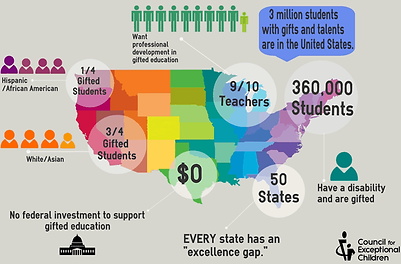
Although there are some approximations, it is difficult to estimate the absolute number of gifted children given that the calculation is dependent on the number of areas or domains being measured and the method used to identify gifted children. This being said, we can determine that children who are in the top 10 percent of a norm qualify for candidacy. (nagc) So, in following this criteria, there are roughly three million people in the United States alone who present with a gifted profile (link).
Prevalence
"an intellectual exceptionality characterized by an unusually advanced degree of general intellectual ability that requires differentiated learning experiences of a depth and breadth beyond those normally provided in the regular school program to satisfy the level of educational potential indicated" (OME, 2017b, p. A16).
The Successful Type 1’s are the most easily identifiable, and may account for up to about 90% of the identified gifted students in schools. They are the students who have learned the system and are well-adjusted to society with a generally high self-concept. They are compliant, display good positive behaviour, and are high achievers, therefore, loved by parents and teachers. However, they can also get bored at school. Some learn the system fast enough so as to use the minimum amount of effort to get by. They can also be dependent on the system, thus less creative and imaginative, and lack autonomy (Schneider, 2015).
The Challenging Type 2’s are the divergently gifted, who possess high levels of creativity. They do not conform to the system and often have conflicts with teachers and parents. They get frustrated, as the school system does not recognize their abilities. They may be seen as disruptive in the classroom and often possess negative self-concepts, even though they are quite creative. This is the group of gifted students who are at risk of dropping out of schools for unhealthy activities, like getting involved or actually exhibiting delinquent behaviour (Schneider, 2015).
The Underground Type 3’s refers to gifted students who deny their talents or hide their giftedness in order to feel more included with a non-gifted peer group. They are generally females, who are frequently insecure and anxious as their belonging needs rise dramatically at that stage. Their changing needs often conflicts with the expectations of parents and teachers. These types appear to benefit from being accepted as they are at the time (Schneider, 2015).
The DropOuts’s Type 4’s gifted are the angry and frustrated students whose needs have not been recognized for many years and they feel rejected in the system. They express themselves by being depressed or withdrawn and responding defensively. They are identified very late; therefore, they are bitter and resentful due to feelings of neglect and have very low self-esteem. For these students, counselling is highly recommended (Schneider, 2015).
The Double Labeled Type 5’s are students who are physically or emotionally impeded in some way, or have a learning disability. This group does not show behaviours of giftedness that can identify them in schools. They show signs of stress, frustration, rejection, helplessness, or isolation. They are also often impatient and critical with a low self-esteem. These students are easily ignored as they are seen as average. School systems seem to focus more on their weaknesses, and therefore fail to nurture their strengths (Schneider, 2015).
Finally, The Autonomous Learners Type 6’s are learners who have learned to work effectively in the school system. Unlike Type 1, they do not work for the system, but rather make the system work for them. They are very successful, liked by parents, teachers and peers, and have a high self-concept with some leadership capacity within their surroundings. They accept themselves and are risk takers, which goes well with their independent and self-directed nature. They are also able to express their feelings, goals, and needs freely and appropriately (Schneider, 2015).





Figure 1 and 2. Characteristics of a student with an indicated gifted profile.

Figure 3. Characteristics of underachievement behaviours in gifted learners.
Figure 4. Positive and negative behaviours that can be expressed in gifted learners.

Figure 5. The differences between bright versus gifted learners.

Figure 6. Common misconceptions of gifted learners.

DID YOU KNOW?
The difference among the gifted can be even greater than the difference between the gifted and the norm. (YT what does it mean to be gifted?)
What does it mean to be gifted? Debunking common myths and misconceptions.
